You know that feeling when you walk into a hotel spa? That instant drop in your shoulders? It isn’t just the smell of eucalyptus or the dim lighting. It’s the way the space feels against your skin. In 2026, we are finally moving past the era of the sterile, all-white box. We are craving warmth. We want depth. And the secret ingredient isn’t a new color palette—it’s texture.
If you are planning a remodel this year, you might be overwhelmed by the choices. There are fluted woods, honed stones, glossy ceramics, and matte metals. How do you mix them without it looking like a chaotic mess? It is simpler than you think. The key is to stop thinking about "matching" and start thinking about "balancing." This guide will walk you through the exact strategies top designers are using right now to create bathrooms that don’t just look good, but feel incredible.
The Shift from Visual to Sensory Luxury
For years, bathroom design was mostly about what looked good in a photograph. Smooth, shiny surfaces dominated because they reflected light well and seemed "clean." But 2026 has brought a major shift. Luxury is no longer just visual; it is tactile. People want to run their hands along a rough-hewn stone wall or feel the grain of warm wood under their feet. This trend toward sensory richness is redefining what a high-end bathroom means.
According to recent insights from global design leaders, the focus is now on materials that shape atmosphere. We are seeing a move away from cold, industrial vibes toward grounded, earthy elements. It is about creating a sanctuary that hugs you. When you choose materials, ask yourself: How does this feel? Does it invite touch? If a surface feels too perfect or too cold, it might not fit the new vibe. The goal is to create a space that feels lived-in and organic, even if it is brand new.
This doesn’t mean you have to sacrifice cleanliness or durability. Modern technology has allowed us to have textured surfaces that are still easy to maintain. For instance, textured tiles can hide water spots better than high-gloss ones. So, you get the best of both worlds: a space that feels cozy and authentic, but still functions perfectly for daily life. It is a win-win situation for anyone tired of scrubbing fingerprints off shiny chrome all day.
The Rule of Three: Balancing Rough, Smooth, and Soft
One of the biggest mistakes homeowners make is trying to use too many different textures at once. It creates visual noise. Instead, stick to the "Rule of Three." Pick three main textural categories: something rough or natural, something smooth or sleek, and something soft or absorbent. This triad creates a balanced composition that feels intentional rather than accidental.
Let’s break it down with a real example. Imagine your shower walls are clad in large-format, honed limestone. That is your "rough/natural" element. It has subtle pits and variations that catch the light. Next, you pair it with a sleek, matte black faucet and a glass shower enclosure. That is your "smooth/sleek" counterpoint. Finally, you add a teak bath mat and plush cotton towels. That is your "soft/absorbent" layer. See how each element plays a different role? They don’t compete; they support each other.
The trick is to vary the scale as well. If you have a highly textured stone wall, keep the floor tiles relatively simple. If you choose a bold, sculptural tile pattern for the floor, keep the walls calm. This hierarchy helps the eye rest. You don’t want every surface screaming for attention. By limiting your primary textures to three, you create a rhythm that guides the viewer through the space without overwhelming them. It is a classic design principle that works every single time.
Stone and Wood: The Power of Natural Contrasts
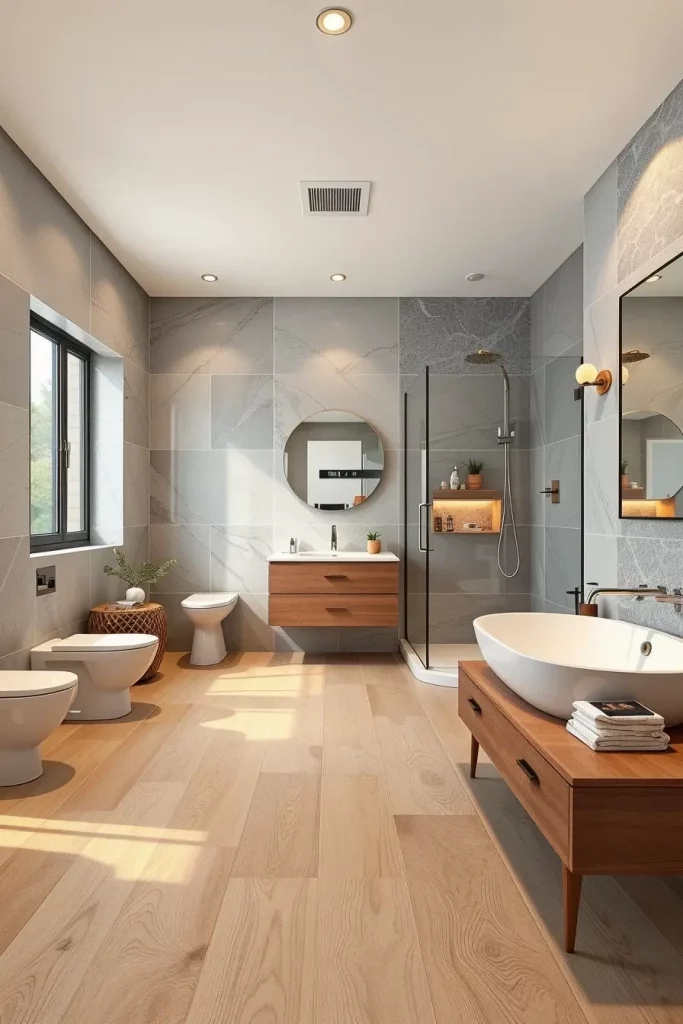
In 2026, the combination of stone and wood is having a major moment. These two materials are natural opposites in terms of temperature and texture, which makes them perfect partners. Stone feels cool, solid, and permanent. Wood feels warm, organic, and inviting. When you put them together, you create a dynamic tension that is incredibly pleasing to the human eye.
Think about using a vanity made of warm walnut or oak. The grain of the wood adds a level of detail that is impossible to replicate with laminate or paint. Pair this with a countertop made of quartzite or marble with a leathered finish. A leathered finish is slightly textured to the touch, unlike a polished surface. This subtle roughness on the stone complements the organic lines of the wood grain. It feels grounded and earthy, connecting your indoor space to the natural world outside.
However, there is a practical side to consider. Bathrooms are wet environments. Wood needs protection. Make sure your wooden elements are properly sealed with high-quality, water-resistant finishes. Or, consider using wood-look porcelain tiles for the flooring if you are worried about maintenance. The visual effect is nearly identical, but the durability is much higher. The key is to ensure the "wood" element, whether real or simulated, has that same warm, textured appearance to contrast with the cool stone.
Playing with Light and Shadow on Sculptural Surfaces
Texture is nothing without light. In fact, texture is basically just a way to manipulate how light hits a surface. In 2026, designers are using sculptural textures to create drama and depth. Think of fluted panels, ribbed tiles, or 3D geometric patterns. These surfaces create tiny shadows that change throughout the day as the light moves. This makes the bathroom feel alive and dynamic, rather than static and flat.
Fluting is everywhere right now. You might see it on vanity fronts, accent walls, or even ceiling details. The vertical lines draw the eye upward, making ceilings feel higher. But more importantly, the ridges catch the light in a way that smooth surfaces never could. If you have a small bathroom with no windows, adding a textured accent wall behind the vanity can add immense interest without needing bright colors. The shadows do the work for you.
Be careful with placement, though. Don’t put highly sculptural textures in areas where they will be hard to clean or where they might collect soap scum. Save the deep grooves for accent walls or dry zones. For wet zones like inside the shower, opt for subtler textures. A lightly tumbled tile or a stone with a natural cleft provides enough visual interest without becoming a nightmare to scrub. Always think about how the light in your specific room will interact with the texture you choose.
The Unexpected Role of Metals and Fixtures
We often think of metals as just functional hardware, but in 2026, they are key textural elements. The finish of your faucet, showerhead, and cabinet pulls can add a crucial layer of complexity to your design. Gone are the days when everything had to match perfectly. Now, mixing metal finishes is not just accepted; it is encouraged. This allows you to introduce different levels of sheen and reflection.
Consider pairing brushed brass fixtures with matte black accessories. The brass has a soft, warm glow with a slight texture from the brushing process. The black is flat and absorbs light. This contrast adds sophistication. Or, try unlacquered brass, which develops a patina over time. This living finish changes texture and color as it ages, adding a sense of history and permanence to the space. It becomes part of the story of your home.
Don’t forget the smaller details. Towel bars, robe hooks, and even the frame of your mirror can contribute to the textural mix. If your walls are very busy with stone or tile, choose simple, smooth metal fixtures to balance it out. If your walls are plain and smooth, you can get away with more ornate or textured metalwork. It is all about equilibrium. The metals should feel like jewelry for the room, adding that final spark of personality.
Avoiding Common Pitfalls in Texture Mixing
While mixing textures is exciting, it is easy to go overboard. The most common mistake is ignoring the background. Your "neutral" surfaces still need to have some character. If you choose a flat, white paint for the walls and pair it with a super textured stone floor, the disconnect can feel jarring. Instead, choose a paint with a slight eggshell or satin sheen, or even a lime wash finish that has subtle movement. This bridges the gap between the extreme textures.
Another pitfall is forgetting about scale. Large textures work best in large spaces. If you have a tiny powder room, a heavy, rough stone wall might feel oppressive. In smaller spaces, opt for finer textures. Small-scale mosaics, fine-grain woods, or subtle fabric patterns work better. They add interest without closing in the room. Always step back and look at the whole picture. Does one element dominate too much? If so, tone it down.
Finally, don’t neglect the soft goods. Rugs, towels, and shower curtains are often an afterthought, but they are vital for comfort. A cold stone floor needs a soft rug. A hard wooden vanity needs soft towels nearby. These fabric elements soften the acoustics of the room too, reducing echo and making the space feel quieter and more serene. Treat them with the same care as you do your tiles and stone. They are the final layer of texture that makes the room habitable.
At the end of the day, your bathroom is a personal space. It is where you start and end your day. The trends of 2026 are not about following rules blindly; they are about giving you the tools to create a space that supports your well-being. By mixing textures thoughtfully, you create an environment that engages your senses and calms your mind. It is about designing for how you feel, not just how it looks.
Start with one piece you love. Maybe it is a beautiful slab of marble or a vintage wooden cabinet. Build your texture palette around that anchor piece. Add contrasting elements slowly. Test samples in your actual space. Look at them in the morning light and the evening light. Feel them with your hands. Trust your instincts. If it feels good, it probably is good.
Remember, perfection is not the goal. Authenticity is. A few imperfections in the wood grain or variations in the stone color add character. They make the space feel human. So, take a breath. Enjoy the process. And create a bathroom that feels like a true retreat from the busy world outside. You deserve a space that nourishes you, one texture at a time.